blog
WHEN “OSHODI BUS-CONDUCTOR MARKETING CULTURE” BECOMES YOUR BRAND CULTURE – By Adetokunbo Modupe

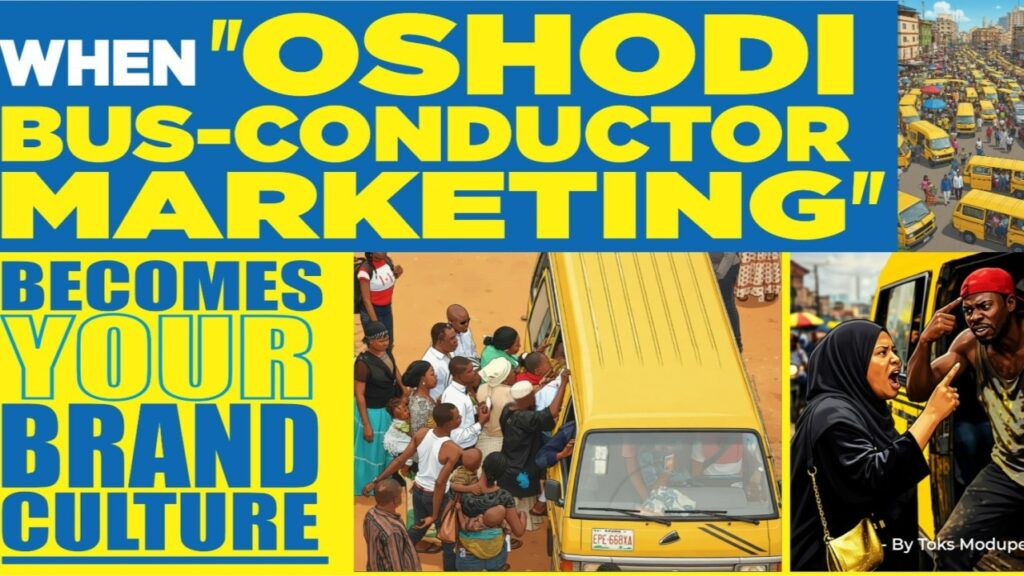
In Public Relations and Marketing Communication, we often say:
Perception is reality.
But data increasingly shows something deeper:
Experience is reputation.
Let me frame it differently.
Across many Nigerian businesses today, a quiet shift is happening—One I describe as “Oshodi bus-conductor marketing.”
Not theory.
A lived—and growing—reality. First, here is a brief description of Oshodi:
Oshodi stands as one of Nigeria’s most iconic intersections—both human and vehicular. Known for its notorious overcrowding, this bustling hub reflects Lagos’ frenetic energy. The demand for transportation here consistently outpaces the available supply, creating a constant state of chaos and confusion.
Yet despite the area’s overwhelming nature, Oshodi remains an unavoidable transit hub for thousands of commuters. Whether heading to work or returning from various corners of the city, it serves as a central point for many navigating the daily grind of Lagos life—it is a place where no one expects quality service, especially from transporters.
The analogy
At Oshodi, the bus conductor operates in a system where:
-Demand overwhelms supply
–Customer choice is limited
-Experience is secondary to transaction
So the approach becomes:
Urgency over empathy
Control over courtesy
Volume over value
It works—in that context.
But it was never designed for brands competing for trust.
Yet, it is creeping into them.
Recently, I experienced this in two “premium” settings:
A hotel booking I made —confirmed, but unavailable on arrival
A high-end restaurant—beautiful ambience, but broken service. I encountered a condescending behaviour, a mixed-up menu, and a forgotten order. Left disappointed and never to return there.
Different sectors. Same signal:
The customer is not central. The transaction is.
Now, here’s what the data says
According to PWC, 73% of consumers say customer experience is a key driver in purchasing decisions—yet only 49% feel companies deliver a good experience.
Research by Zendesk shows that over 60% of customers will switch brands after just one poor experience.
Forrester Research reports that emotion—not price or effort—is the strongest driver of customer loyalty.
And perhaps most critical: word of mouth now travels at digital speed. A single poor interaction is no longer private—it is amplifiable.
Why this matters for PR and consulting
This isn’t just a service failure.
It is a reputation risk multiplier.
Because:
Every interaction is a brand signal
Every employee is a reputation carrier
Every experience is a communication channel
You cannot out-communicate a broken experience.
No campaign, no media visibility, no brand narrative can sustainably mask consistent indifference to service.
The real risk
When “bus-conductor marketing” becomes cultural:
Brands stop listening
Customers’ lower expectations—or walk away
Mediocrity becomes institutionalised
And the most dangerous outcome?
Not outrage. No complaints.
But a quiet customer exit and an adverse advocate recruitment.
From a consulting lens, three questions matter
1. Are we operating a demand-dominant mindset?
(Where customers are seen as replaceable?)
2. Is our internal culture aligned with our external promise?
(Or are we selling premium but delivering indifference?)
3. Do our people understand they are the brand?
(Especially at the point of experience?)
Because ultimately
Reputation is no longer built in campaigns.
It is built in:
Moments of interaction
Points of friction
Service recovery—or the lack of it
Final thought
“Oshodi bus-conductor marketing” works where customers have no choice.
Strong brands are built where customers always do.
Have you seen this pattern in your industry?
More importantly, are organisations truly addressing it, or just managing perception?
#CustomerExperience #BrandReputation #PublicRelations #MarketingStrategy #BusinessCulture#ReputationManagement#leadership#Customerservice
FG, Lagos State Government Synergize to Deliver 24/7 Power as Energy Zones Kicks Off

TPT International Wins Double Honours at 2026 EDGE Awards as Adetokunbo Modupe is Named PR Industry Legend
World Environment Day: Rite Foods Takes Climate Campaign to Schools

STUNT: PUBLICITY QUICK-FIX OR SUSTAINABLE PR TRIGGER? By Adetokunbo Modupe