blog
THE CRISIS OF CRISIS COMMUNICATIONS – Adetokunbo Modupe

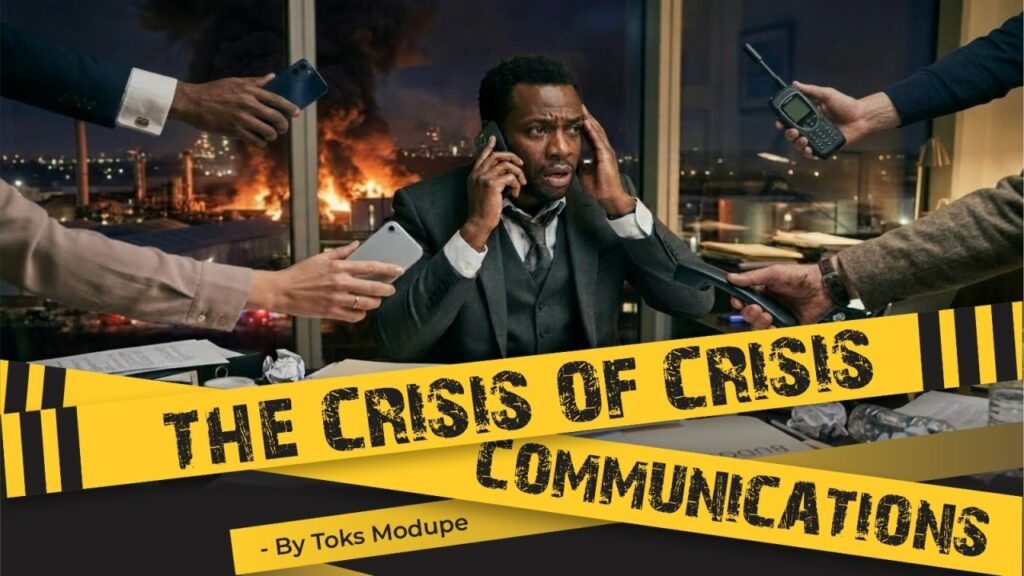
At exactly 10:25 pm (GMT+1) on a seemingly ordinary Friday night, I had just settled into bed and turned on Animal Planet, my favourite channel, when my phone rang.
Reluctantly, I answered.
“Sorry, I am calling a bit late. There’s a big problem,” the client contact said.
“Our factory is on fire.”
My immediate question was :
“Have the firefighters been called?”
“Yes,” he replied. “But that’s not the real problem.”
The real concern was how to manage information without corporate bruises.
“Our AGM is in two weeks,” he added nervously. “If news breaks that our major brewery is on fire, it could affect our stock value. This hasn’t been our best financial year. We can’t afford negative publicity before the AGM. I have just a draft statement to the MD, but have yet to receive his approval”.
While we were still speaking, the situation appeared to be escalating.
Another colleague sent a message asking for confirmation. He had been contacted by a friendly blogger.
Minutes later, the calls started coming in—from journalists and some internal stakeholders. We later found out that the MD was confused about the appropriateness of issuing a statement at the time. It became clear:
This wasn’t just a crisis.
It was a crisis of crisis communication.
WHEN CRISIS CREATES COMMUNICATION CHAOS
In moments of crisis, organisations often face confusion, panic, safety concerns, and intense scrutiny.
Under this pressure, clear thinking becomes difficult.
Decisions are rushed. Messages are inconsistent. Internal disagreements slow down responses.
And the result?
Reputational damage that can last far longer than the crisis itself.
At times like this, organisations must communicate with messages that are:
Fast. Clear. Transparent. Reassuring
But many companies struggle with the most basic questions:
Who should speak?
What should be said?
How quickly should we respond?
When those answers are unclear, communication becomes part of the crisis.
THE POWER OF PREPARATION
Fortunately, in this situation, we activated our Crisis Communication Mechanism (CCM).
This structure allowed us to:
• Establish a clear communication chain
• Craft accurate messaging quickly
• Identify priority stakeholders
• Coordinate media responses
With a structured process in place, the organisation stabilised communication and managed the narrative before speculation took over.
But the experience reinforced something I’ve seen repeatedly in my work.
Many organisations are not truly prepared for crisis communication.
THE CRISIS BEHIND THE CRISIS
Most companies understand operational crises.
Fires. Accidents. Product failures. Sex scandals. Financial shocks.
But what many underestimate is the communication crisis that follows.
When a crisis hits, organisations must manage information, perception, and trust—simultaneously and under pressure.
Without preparation, communication becomes reactive instead of strategic.
And reactive communication almost always makes things worse. More errors and more resources.
THE MISSING PIECE: REPUTATIONAL RISK MANAGEMENT
Through years of working with organisations during difficult moments, one issue stands out.
Many companies lack a structured approach to identifying and managing reputational risk.
I refer to this as ORRIM — Organisational Reputational Risk Identification and Management.
Without it, crisis communication becomes improvisation.
Managing corporate reputation without a reputational risk framework is like:
• Flying an aircraft without maintaining the engine
• Fighting a virus without a vaccine
• Running a company without a risk strategy
Sooner or later, something will fail.
ARE WE FOCUSING ON THE WRONG THING?
In many professional conversations, we discuss crisis management extensively.
But we rarely focus enough on reputational risk preparedness. The underlying factor in crisis mitigation and management.
And that raises an important question:
Are we missing the point if we talk about crisis communication without first identifying and managing reputational risks?
Without that foundation, organisations cannot prevent crises.
They are simply preparing to react to them.
FINAL THOUGHT
In my over three decades of experience, the most dangerous moment in any crisis is not the incident itself.
It is the moment when an organisation realises it has no clear plan for communicating about it.
That is when the real crisis begins.
The crisis of crisis communication.
A question for leaders and communication professionals:
Does your organisation have a clear framework for identifying reputational risks before a crisis happens?
Or are you relying on improvisation when the pressure arrives?
FG, Lagos State Government Synergize to Deliver 24/7 Power as Energy Zones Kicks Off

TPT International Wins Double Honours at 2026 EDGE Awards as Adetokunbo Modupe is Named PR Industry Legend
World Environment Day: Rite Foods Takes Climate Campaign to Schools

STUNT: PUBLICITY QUICK-FIX OR SUSTAINABLE PR TRIGGER? By Adetokunbo Modupe