blog
Faith Marketing vs Product Marketing – Adetokunbo Modupe

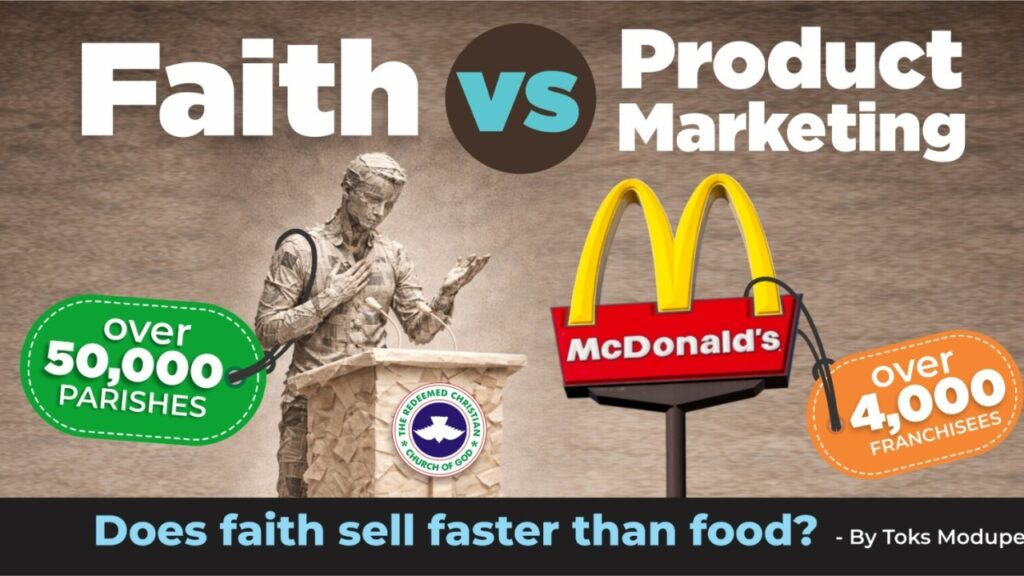
McDonald’s, with over 4,000 locations worldwide, is the largest franchise-operated food chain. However, the Redeemed Christian Church of God has over 50,000 parishes or worship outlets.
One sells burgers. The other offers faith. Both run on remarkably similar business models.
Before you push back, this isn’t a commentary on anyone’s belief. It’s an analysis of one of the most effective growth models I’ve ever studied. That it happens to be a church makes it more interesting, not less.
Faith as an intangible product?
In marketing, a product is anything designed to satisfy a need — tangible or intangible. A car is a product. So is insurance. So is banking.
Faith fits that definition, and perhaps more. It is desired, pursued, embraced, and retained. And through organised institutions, it is structured, communicated, and distributed to audiences seeking meaning, reassurance, and community.
The question isn’t whether faith has value. It clearly does — emotional, psychological, social, and often economic. The question is: how do you scale something invisible to 195 countries?
The answer, it turns out, looks a lot like what the Redeemed Christian Church of God (RCCG) has achieved—franchising.
The McDonald’s playbook
Franchise marketing works on a simple principle: a central brand expands by empowering local operators who adopt its identity, standards, and systems. The parent organisation grows rapidly with reduced risk, as local operators invest their own resources while adhering to centralised controls.
Among global franchise brands, McDonald’s remains one of the most recognised examples. With a market valuation exceeding $230 billion and an enterprise value approaching $300 billion, more than 90% of its outlets operate under franchise agreements. Its model thrives on universal demand—food is non–negotiable.
McDonald’s food is consistent whether you’re in New York, Kenya, Lagos or London. The brand is unmistakable. The model is built for scale.
Now apply that same structural logic to something intangible.
How RCCG built a global Faith-based brand
Founded in 1952 by Josiah Akindayomi, the Redeemed Christian Church of God entered a new era in 1981 under Enoch Adeboye, a former mathematics lecturer who operationalised a spiritual vision using principles that would impress any growth strategist.
The church built a multi-layered structure — national headquarters, regions, provinces, zones, and parishes. Each parish operates with local autonomy but remains doctrinally and administratively aligned with the centre.
RCCG doesn’t plant churches the way corporations open branches. They train and certify pastors, then release them to build — with freedom over local execution but with zero deviation from core doctrine. Financial contributions flow upward to sustain the broader organisation, creating shared responsibility and collective growth. This structure allows the headquarters to focus on more important developmental issues.
It’s the most disciplined decentralisation model I’ve seen outside of a tangible products franchise business.
The result? Over 50,000 branches worldwide, making RCCG one of the fastest-growing Pentecostal movements in history. While no official valuation exists, the scale of its infrastructure and global footprint rivals those of major corporations.
And here’s what Adeboye got right that many commercial brands get wrong: he modernised the worship style without abandoning doctrinal identity. He made the brand accessible to new generations while preserving its foundation. That balance between tradition and relevance is something most companies spend millions trying to achieve.
What brand builders should take from this
The lessons here aren’t abstract. They’re operational.
RCCG scaled because the mission was simple enough for every local operator across 195 countries to understand. No ambiguity. No dilution. That kind of clarity is rare in corporate branding — and it shows.
They scaled because standardisation wasn’t optional. Every parish looks and feels like an RCCG parish. The brand doesn’t bend to whoever’s running the local unit. Commercial franchises spend enormous resources enforcing this. RCCG built it into the culture from the start.
And perhaps most importantly, they built loyalty not around a product, but around shared conviction. The strongest brands in the world aren’t just consumed. They’re believed in. Apple understands this. Nike understands this. RCCG understood it before any of them.
One final thought
Faith isn’t sold like a burger. But it can be distributed with the same strategic discipline. When intangible conviction meets structured expansion, the result is proof that marketing — at its core — isn’t about commerce. It’s about value creation, trust, and scalable relationships.
Whether you’re building a business or a movement, the formula is the same: vision without structure stays local. Structure without vision stays empty. Combine the two, and you get global influence.
What’s the most unconventional business model you’ve studied? I’d love to hear what surprised you
FG, Lagos State Government Synergize to Deliver 24/7 Power as Energy Zones Kicks Off

TPT International Wins Double Honours at 2026 EDGE Awards as Adetokunbo Modupe is Named PR Industry Legend
World Environment Day: Rite Foods Takes Climate Campaign to Schools

STUNT: PUBLICITY QUICK-FIX OR SUSTAINABLE PR TRIGGER? By Adetokunbo Modupe